Pro Breeze Dehumidifiers Compared: Mini, 1500ml, 12L, 20L, 30L Smart & 10L Desiccant (UK 2026)

Search for a Pro Breeze dehumidifier and you will find eight models that look like one family but are really three different kinds of machine, plus a silica gel absorber. The small ones use Peltier plates, the big ones use a compressor, one uses a desiccant, and the smallest of all uses no power at all while it is working. The model names do not tell you which is which, and the "1500ml" in two of the names is not the figure most people think it is.
This guide sorts the range by what each unit actually does, compares the specs that matter, works out what each one costs per litre of capacity, and tells you which one to buy for your space.
Pro Breeze in brief
Pro Breeze is a UK home appliance brand best known for dehumidifiers, fans and heaters, and it sells mainly through Amazon. Its dehumidifier range runs from a £20 wardrobe absorber to a 30L/day compressor unit with app control, and the prices are consistently lower than the premium names like Meaco and De'Longhi.
The single most useful thing to know before you choose: the technologies are not interchangeable. A Peltier mini will not dry a damp house, a compressor unit struggles in a cold garage, and the desiccant model is the only one built for the cold. Pick the technology first and the size second.
The Pro Breeze range at a glance
| Model | Type | Extraction | Tank | Stand-out feature | Best for |
|---|---|---|---|---|---|
| Rechargeable Mini | Silica gel, no power while working | Holds about 150ml, then recharge | None, absorbs internally | Cordless, recharges from the mains | Wardrobes, cupboards, drawers |
| 500ml Mini | Peltier | Up to 250ml/day | 0.5L | Tiny and near silent | Small cupboards, caravans |
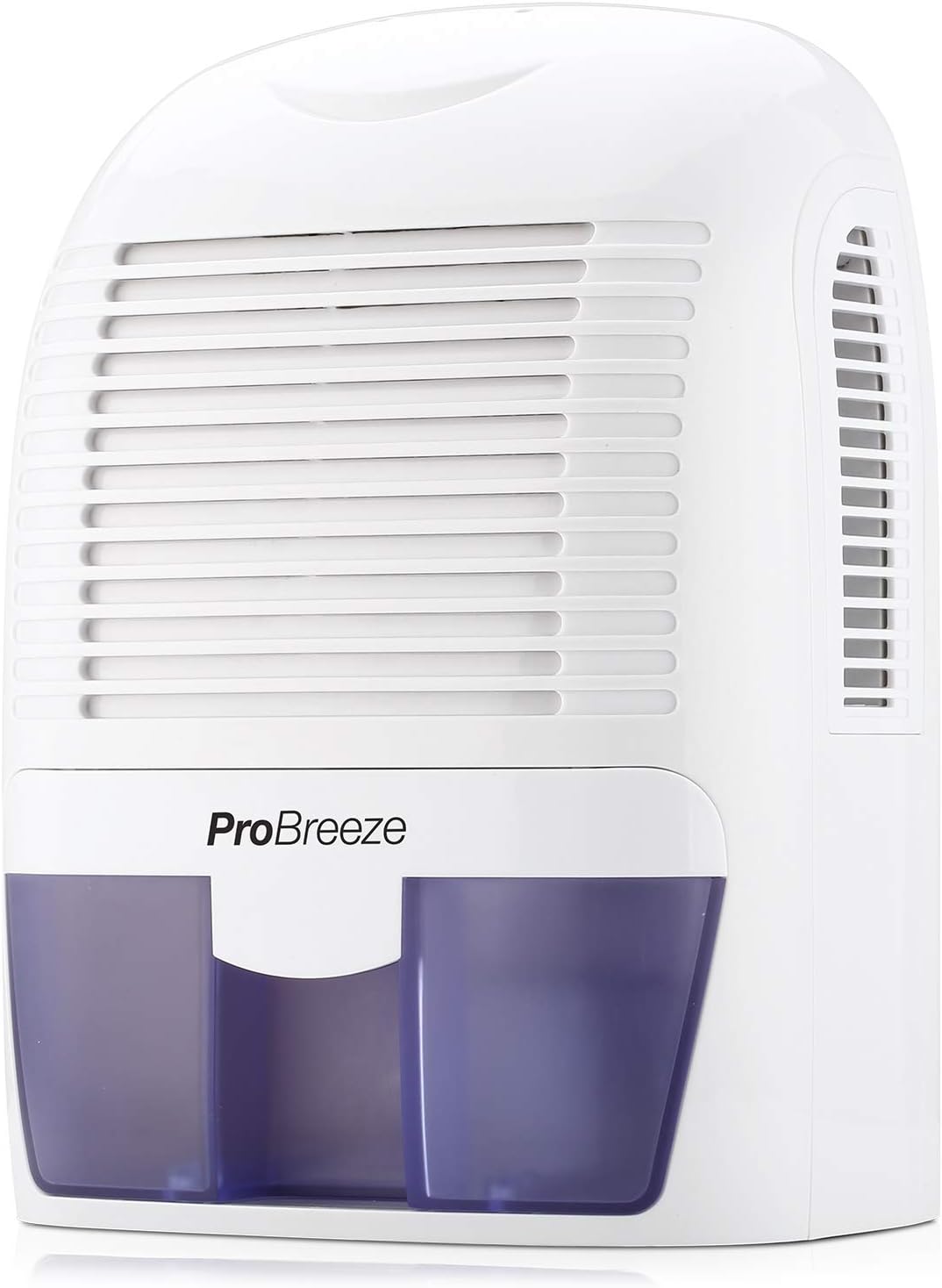
| 1500ml | Peltier | Up to 500ml/day | 1.5L | Bigger tank, less emptying | Small bedrooms, ensuites |
| 1500ml Premium | Peltier | Up to 500ml/day | 1.5L | Lower energy use, 10 to 50°C range | Rooms up to about 220 sq ft |
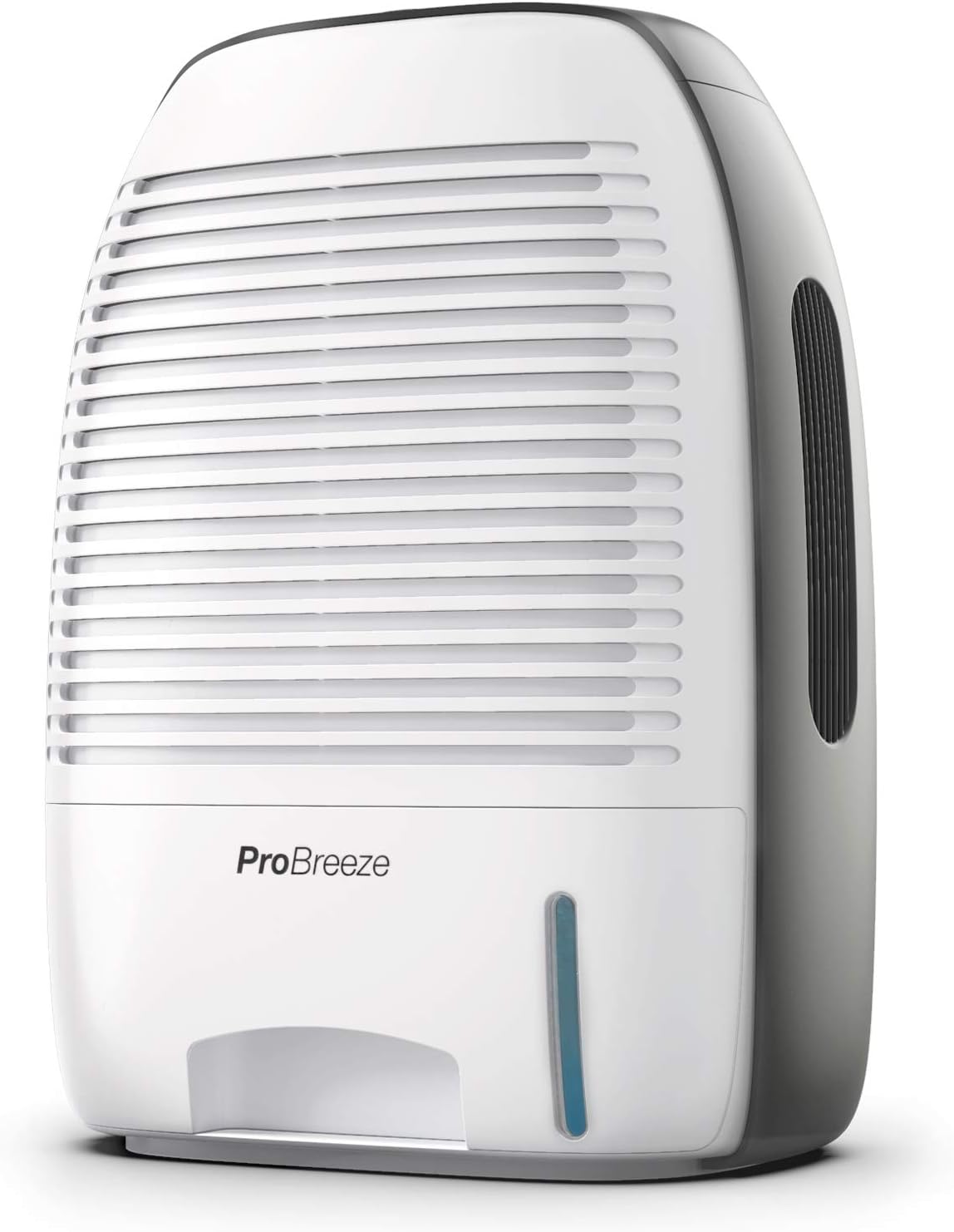
| 12L/Day | Compressor | Up to 12L/day | 1.8L | Compact, sleep mode | Flats, one or two damp rooms |
| 20L/Day | Compressor | Up to 20L/day | 5.5L | Biggest tank, laundry mode | Laundry drying, larger houses |
| 30L/Day Smart | Compressor | Up to 30L/day | 3L | WiFi app, turbo mode | Very damp or large homes |
| 10L/Day Desiccant | Desiccant | Up to 10L/day | 3L | Works down to 1°C | Garages, basements, unheated rooms |
What you pay per litre, and how often you empty the tank
Two numbers that no product listing gives you are the price of each litre of daily capacity and how many times a day the tank fills. Both change the buying decision, so we worked them out from the Amazon UK prices on 12 October 2026.
| Model | Price (12 Oct 2026) | Rated extraction | Price per litre/day of capacity | Tank | Tank fills at full rated output | Tank fills at a typical 3L/day |
|---|---|---|---|---|---|---|
| 12L/Day | £134.99 | 12L/day | £11.25 | 1.8L | 6 to 7 a day | Nearly 2 a day |
| 20L/Day | £179.99 | 20L/day | £9.00 | 5.5L | 3 to 4 a day | About every 2 days |
| 30L/Day Smart | £189.99 | 30L/day | £6.33 | 3L | 10 a day | Once a day |
| 10L/Day Desiccant | £199.99 | 10L/day | £20.00 | 3L | 3 to 4 a day | Once a day |
What the table shows:
- The 30L Smart is the cheapest capacity in the range by a wide margin. It costs £10 more than the 20L and gives you half as much extraction again, which works out at £6.33 for each litre of daily capacity against £9.00 for the 20L and £11.25 for the 12L.
- The 12L is the cheapest to buy, by £45. If your damp problem is one or two rooms, the extra capacity of the bigger units is money you will never use.
- The 20L wins on tank size, not on price. At a realistic 3 litres a day it runs for about two days between empties. The 12L needs emptying nearly twice a day and the 30L once a day.
- The desiccant looks poor value on paper and is not. Its £20 per litre is the price of a machine that still works at 1°C. In a cold garage the compressor units cannot deliver their rated figure at all, so the comparison only holds in a heated room.
- No tank copes with full rated output. A 30L machine working flat out would fill its 3L tank ten times a day. If you are buying a big unit for a serious damp problem, plan to use the drainage hose that comes in the box.
The "typical 3L/day" column is our working assumption for a heated UK home in winter, not a manufacturer figure. Rated extraction is measured in warm, very humid test conditions, and most homes collect a fraction of it.
The Peltier minis sit on a different scale. The 500ml Mini is £34.99 and the 1500ml is £49.99, so the extra £15 buys double the extraction (500ml a day against 250ml) and a tank that lasts three days at full output, not two. Unless the space is a cupboard, the 1500ml is the better buy of the two. Prices on this range move often, so check the current figure on each product page.
What "1500ml" actually means
This is the most common misunderstanding with Pro Breeze, so it is worth clearing up before the model-by-model detail.
1500ml is the size of the water tank, not the amount the unit removes. Both 1500ml models extract up to 500ml a day. The 500ml Mini works the same way: a 500ml tank, but only up to 250ml a day of extraction.
That is not a flaw, it is what Peltier technology does. There is no compressor, so the units are small, light and quiet enough for a bedroom, but they remove a fraction of what a compressor machine does. For a small room with light condensation that is plenty. For a room with water running down the windows every morning, or for drying washing, you need a compressor unit.
To put the gap in numbers: the 12L/Day is rated to remove 24 times as much water as the 1500ml, for less than three times the price.
Pro Breeze Rechargeable Mini: for wardrobes and cupboards
The Pro Breeze rechargeable mini dehumidifier is not really an electric dehumidifier at all while it is working. It is a sealed pot of silica gel crystals that draws moisture from the air with no power, no noise and no tank to empty.
How it works. A window on the front changes from orange to green as the crystals fill up. It holds around 5 ounces (roughly 150ml) of moisture and typically lasts 20 to 30 days before it needs recharging. To recharge, you plug it into the mains for 8 to 10 hours, and the built-in heater drives the moisture back out. Do that somewhere well ventilated, not inside the wardrobe you are trying to dry.
Where it fits. Wardrobes, cupboards, shoe racks, safes, drawers and storage boxes. Anywhere enclosed and small. It will do nothing measurable to an open room.
Pick the Rechargeable Mini if: you want to protect clothes, shoes or stored items in an enclosed space, and never buy a replacement absorber again. Our guide to battery and cordless dehumidifiers covers this category in more depth.
Pro Breeze 500ml Mini: the smallest electric model
The Pro Breeze 500ml mini dehumidifier is a Peltier unit that removes up to 250ml a day into a 500ml tank, so you empty it roughly every two days in steady use. It switches itself off when the tank is full.
It is small enough to sit on a shelf and quiet enough to forget about. That makes it a sensible choice for a boot room, a large cupboard, a caravan or a small bathroom without an extractor. It is not enough for a bedroom with real condensation.
Pick the 500ml Mini if: the space is small, enclosed and only mildly damp, and you want mains power rather than recharging.
Pro Breeze 1500ml: the popular small-room pick
The Pro Breeze 1500ml dehumidifier doubles the extraction of the 500ml model to 500ml a day and triples the tank to 1.5L, so you empty it every two or three days rather than every one or two. It uses the same Peltier technology, so it is still light, compact and very quiet, with an automatic shut-off and an indicator light when the tank is full.
This is the model most people end up with for a single bedroom, a study or an ensuite with low-level condensation, and it is usually the cheapest way to get that job done properly. It is also by far the most reviewed unit in the range, with more than 37,000 ratings on Amazon UK at an average of 4.1 stars.
Pick the 1500ml if: you have one small room with light condensation and want the least fuss for the least money.
Pro Breeze 1500ml Premium: the same job, a little better
The Pro Breeze 1500ml Premium has the same 500ml/day extraction and the same 1.5L tank as the standard 1500ml, so on paper it does the same job. The differences are in the details:
- Pro Breeze claim it uses up to 45% less energy per hour than similar models. That is a manufacturer figure, not an independent test, but the unit is rated for rooms up to 2,200 cubic feet (around 220 square feet of floor space).
- It has a wider stated operating range of 10 to 50°C.
- The top of the tank lifts off completely, which makes it much easier to clean, and there is a window to see the water level.
Whether that is worth the few pounds extra depends on how long you will run it. For a unit on most of the day through winter, the lower running cost and easier cleaning are worth having.
Pick the 1500ml Premium if: it will run for long hours in a bedroom or office and you want the easier-to-clean tank.
Pro Breeze 12L/Day: the compact compressor
The Pro Breeze 12L/Day dehumidifier is the entry point to the compressor range and a very different machine from the minis. It extracts up to 12 litres a day, weighs 9.5kg and measures 22 x 30 x 44cm, so it is still small enough to move between rooms. Its Amazon listing carries a Which? Best Buy award, and it holds 4.6 stars from more than 5,600 ratings.
Controls. A digital display and humidistat let you set a target between 30% and 80% humidity, and the unit switches off when it gets there. There are three modes (auto, continuous and sleep), a 24-hour timer and a child lock.
The catch is the tank. At 1.8L it is small for a 12L/day machine. Running hard against real damp, you will be emptying it more than once a day. A drainage hose is included, and if you can route it to a sink or drain, continuous drainage removes the problem entirely.
Pick the 12L if: you have a flat or one or two damp rooms in a heated home, and space for a hose or the patience to empty a small tank.
Pro Breeze 20L/Day: the laundry workhorse
The Pro Breeze 20L/Day dehumidifier is built for households that dry washing indoors. It extracts up to 20 litres a day and has the largest tank in the range at 5.5L, which is the feature that matters most when you are pulling a full load of washing dry overnight.
It has four modes including a dedicated laundry mode, plus fan only, auto-defrost so it keeps working as the room cools, a child lock, a 24-hour timer and a sleep display that dims the screen at night. The humidistat runs from 30% to 80%, and four wheels make it easy to move.
Pick the 20L if: drying laundry indoors is the main job, or you want to empty the tank as rarely as possible without plumbing in a hose.
Pro Breeze 30L/Day Smart: the flagship
The Pro Breeze 30L/Day Smart dehumidifier is the most capable unit in the range and the only one with WiFi and a smartphone app. It removes up to 30 litres a day and works in temperatures between 5°C and 32°C, with auto-defrost for the cooler end of that range. It holds 4.3 stars from over 800 ratings on Amazon.
The app is genuinely useful. You can check the room's humidity, change the target (anywhere from 25% to 85%), switch between auto, turbo and continuous modes, and build a schedule so it runs while you are out and stays off overnight. The same controls are on the unit's own panel if you would rather not use the app.
Tank and drainage. The 3L tank is smaller than the 20L's 5.5L, which is the one place the flagship gives something up. For a machine this powerful, continuous drainage through the included hose is the realistic way to run it against serious damp.
Pick the 30L Smart if: you have a large or very damp home, you want app control and scheduling, or the price gap to the 20L is still as small as it usually is.
Pro Breeze 10L/Day Desiccant: the one for the cold
The Pro Breeze 10L/Day desiccant dehumidifier is the model to buy for anywhere that is not heated. Compressor dehumidifiers work by chilling the air below its dew point, and they lose efficiency sharply once the room drops below about 15°C. A desiccant unit absorbs the moisture instead, so it keeps working in temperatures as low as 1°C.
That makes it the right choice for a garage, a basement, a conservatory, a boat or a static caravan through winter. It has a 3L tank with automatic shut-off, a drainage hose in the box, a humidistat that switches it off at your target level, a timer and a swinging louvre to direct the airflow. As a bonus, desiccant units blow out slightly warm air, which helps in a cold space.
The trade-off is cost. It is the most expensive model in the range to buy, and in a heated living room a compressor unit removes more water for the same electricity, so this is not the model to choose for the house itself.
Pick the 10L Desiccant if: the space is cold or unheated. In a garage in January it will outperform a compressor unit with a much higher rating.
Which Pro Breeze should you buy?
- A wardrobe, cupboard or storage box: Rechargeable Mini.
- A small cupboard, boot room or caravan, mains powered: 500ml Mini.
- One small bedroom or ensuite with light condensation: 1500ml, or the 1500ml Premium if it will run for long hours.
- A flat or one or two damp rooms in a heated home: 12L/Day.
- Drying laundry indoors, fewest tank empties: 20L/Day.
- A large or very damp house, the best price per litre, or you want app control: 30L/Day Smart.
- A garage, basement, conservatory or anywhere unheated: 10L/Day Desiccant.
If you are still deciding between brands rather than between Pro Breeze models, our best dehumidifiers UK comparison puts the Pro Breeze units alongside Meaco, Honeywell, De'Longhi and Cosi Home, and our Avalla range guide covers the closest rival at a similar price.
Frequently asked questions
Is the Pro Breeze 1500ml dehumidifier any good? For the right room, yes. It removes up to 500ml a day, which clears light condensation in a small bedroom, study or ensuite, and it is quiet enough to run overnight. It will not cope with a large room or heavy damp, because it uses Peltier technology rather than a compressor. If your windows are streaming every morning, you need the 12L or larger.
What is the difference between the Pro Breeze 1500ml and the 1500ml Premium? Extraction and tank size are the same, 500ml a day into a 1.5L tank. The Premium claims up to 45% lower energy use, has a wider 10 to 50°C operating range, a fully removable tank lid for cleaning and a water-level window. It costs a little more.
Does the Pro Breeze 30L dehumidifier have an app? Yes. It is the only Pro Breeze dehumidifier with WiFi. The free app shows the current humidity, sets the target level, switches modes and lets you schedule it to turn on and off. Everything can also be done from the panel on the unit.
Pro Breeze 20L or 30L: which should I buy? The 30L extracts more, adds app control and has a turbo mode. The 20L has the bigger tank, 5.5L against 3L, so it needs emptying less often if you are not using a drainage hose. On 12 October 2026 the 30L was £189.99 and the 20L £179.99, so the 30L cost £6.33 per litre of daily capacity against £9.00. If you will run a hose, the 30L is the better buy. If you will empty it by hand every day, the 20L's tank is a real advantage.
Which Pro Breeze dehumidifier is the best value? Among the compressor models, the 30L Smart, at £6.33 per litre of daily capacity on 12 October 2026. The 12L is the cheapest to buy outright at £134.99 and is enough for a flat or a couple of damp rooms. Among the minis, the 1500ml gives double the extraction of the 500ml for about £15 more.
Which Pro Breeze dehumidifier works in a cold garage? The 10L/Day Desiccant. It keeps working down to 1°C, where the compressor models (12L, 20L and 30L) lose much of their extraction. The Peltier minis are also a poor fit for the cold.
How often will I need to empty a Pro Breeze dehumidifier? It depends on the tank more than the extraction rate. Collecting a typical 3 litres a day, the 20L (5.5L tank) goes about two days between empties, the 30L and the desiccant (3L tanks) need emptying daily, and the 12L (1.8L tank) nearly twice a day. All four come with a hose for continuous drainage, which removes the job altogether.
How do I recharge the Pro Breeze rechargeable mini dehumidifier? When the indicator window turns green, take it out of the space it is drying and plug it into a mains socket for 8 to 10 hours in a well-ventilated room. The crystals release the moisture they have absorbed, the window returns to orange, and it is ready to go back in.
How much water should a Pro Breeze dehumidifier collect? Much less than the headline figure, in most homes. The litres-per-day rating is measured in warm, very humid test conditions. In a heated UK room at normal winter humidity, a 20L unit might collect a few litres a day, and less once the room is dry. Collecting less water over time is a sign it is working, not failing.
What humidity should I set my Pro Breeze dehumidifier to? Around 50%. Between 45% and 55% stops mould and condensation without over-drying the air. Setting it lower just makes it run longer and cost more.
Prices were checked on Amazon UK on 12 October 2026 and change often. Check the latest price on each product page before you buy.
Featured Products

£189.99
£134.99
£69.99
£64.99


£199.99
£179.99

£189.99
£199.99